
LOCAL SEO · GOOGLE MAPS · Punta del Este · Maldonado
How to appear on Google Maps in Punta del Este: a local SEO guide for businesses
Showing up on Google Maps is only the beginning. Build a consistent local presence, connect it to your website and turn relevant searches into enquiries your business can handle.

Appearing on Google and ranking better are not the same thing
The first objective is to make sure Google can represent your business correctly. For an eligible business, that starts with creating or claiming its Google Business Profile, completing verification when required and keeping the name, category, location or service area, hours, phone, website, photos, services and reviews accurate.
Having a profile does not guarantee a first-place position. Separate two questions: presence —does Google understand that your business exists and what it does?— and ranking —is it a relevant answer to this search, from this location, compared with the available alternatives? Solve the first problem before trying to optimise the second.
Reference: Google · Guidelines for representing your business
Understand how Google decides what to show
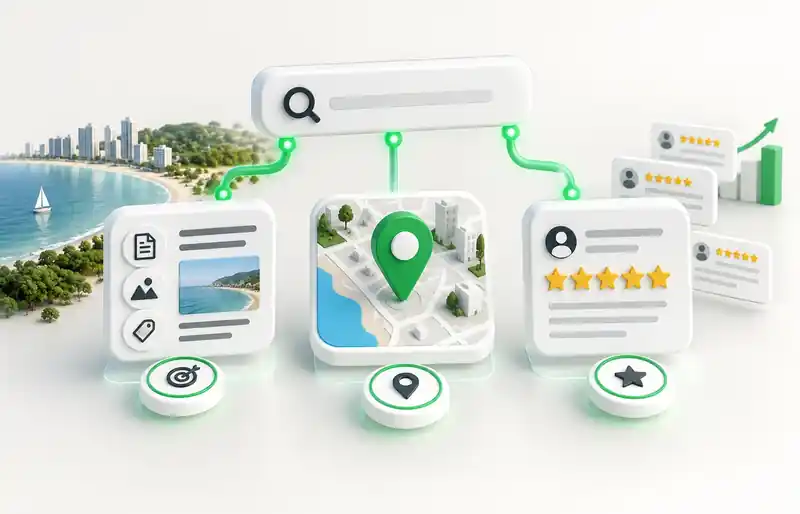
Google summarises local ranking around three factors: relevance, distance and prominence. Relevance measures how well a business matches the search; distance considers where the searcher is in relation to the relevant business or area; and prominence uses signals that help Google understand how established or well known a business is.
That means there is no single permanent Maps position. Two people can make a similar search from different places and see different results. A screenshot showing a business as “number one” is not, on its own, evidence of a strong local strategy.
The practical consequence matters: local SEO does not live only inside Maps. Your website, mentions, links, reputation and reviews are part of the same ecosystem.
Reference: Google · Tips to improve local ranking
Start with an accurate profile, not an over-optimised one
Use the real business name and choose the category that best represents the primary activity. Do not add locations or services to the name simply to rank, and do not turn the profile into a catalogue of activities the business does not provide.
The address or service area should reflect how the business actually operates. Do not invent offices to appear in more cities. Keep opening hours, phone and website current: in a seasonal market such as Punta del Este, an incorrect opening time in January can cost an enquiry even when your SEO is excellent.
Test the contact journey on a phone. Acquisition loses value if it ends at a number nobody answers, a broken form, a website that does not explain the service or a WhatsApp conversation nobody follows up.

Reference: Google · Guidelines for representing your business
Explain services the way customers understand them
A category can tell Google what kind of company you are. Your website can explain what you solve. “Notarial services” may be technically correct, but an international client may be looking for a property transaction, power of attorney from abroad, company incorporation, a notarial certificate, residency documentation or an inheritance matter. Real estate can separate investment, sales, rentals and international buyers. Hospitality can separate accommodation, experiences, concierge and mobility.
A useful page answers four questions before contact: do you provide what I need, do you serve my area, do you work with clients like me and what should I do next? Do not create a hundred pages by changing only the neighbourhood name; a new URL should correspond to a genuinely different need or search intent.
Connect Google Maps to a website built to convert
A Maps visitor may already have strong intent. Do not waste it by sending everyone to a homepage that tries to explain the entire company at once. A service page should make it clear what you offer, who it is for, where you provide it, what is included, what the customer needs and what they should do next.
Check consistency between Google —name, activity, location, phone and services— and the website —brand, services, area, contact and company information—. This does not mean repeating every word; it means both surfaces describe the same business.
Also read: Your website in Punta del Este — what to review before investing more
Reviews are reputation before they are SEO
When someone compares similar alternatives, reviews reduce uncertainty. Google recommends responding to them and notes that review volume and positive ratings can contribute to local ranking.
Do not turn this into a race for stars. Build a legitimate process: service completed → request review → provide the link → thank the customer → respond. Do not dictate what a customer should write or buy reviews. The signal worth building is a real, consistent customer experience.
A useful review helps the next customer decide; a useful response shows how the business behaves when the conversation is public.
Reference: Google · Tips to improve local ranking
Use real photos to answer questions text cannot
The question is not how many photos to upload. It is what a potential customer needs to see before trusting the business. A hotel can show rooms, common areas and surroundings; a restaurant can show food and atmosphere; a professional practice can show its office and team; a real estate firm can show properties, people and location.
Use real photography when visuals affect the decision. Generic stock can look polished while reducing credibility because it does not show the actual experience.
Build authority beyond your own website
Ask where it makes sense for the business to appear: professional associations, chambers, local media, suppliers, partners, events, industry organisations, joint projects and genuinely relevant directories.
This is not about automatically submitting the company to hundreds of directories. A worthwhile mention or link should remain useful even if Google did not exist because it can add reputation, context or direct customers.
Punta del Este also requires an international search strategy
For some Punta del Este businesses it makes sense to serve searches and customers in Spanish, English and Portuguese. Translating the navigation is not enough: people should understand the service, requirements, next steps, contact options and whether someone can actually assist them in that language.
Language versions should use their own URLs and a coherent technical implementation. Where appropriate, hreflang helps relate those versions. The commercial rule matters even more: do not promise a language experience that operations cannot support.
Reference: Google Search Central · Localized versions and hreflang
The real objective: turn a search into an enquiry
Imagine someone searches for “Punta del Este investment real estate”, finds your company, checks the reviews, opens your website and wants to get in touch. A healthy journey can look like Google → relevant page → WhatsApp → qualification → advisor → next step.
The first conversation can capture transaction type, budget, preferred area, timing, language and objective. Not everything needs automation, but context should not disappear. When volume justifies it, WhatsApp can connect to commercial workflows that register and organise enquiries while clearly defining what can happen automatically and when a person must take over.
SEO captures intent. Operations determine how much that intent is worth.

Measure whether local SEO is creating business
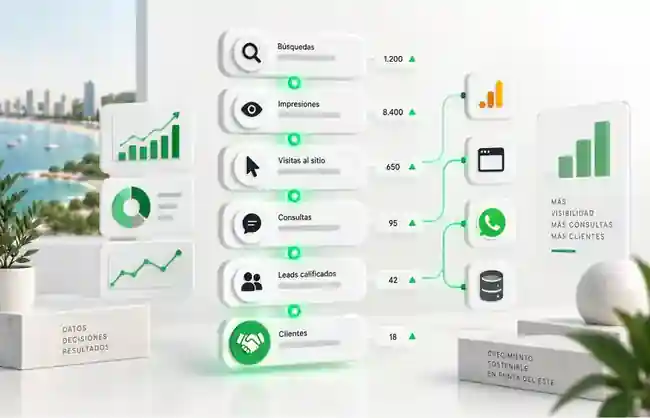
Do not measure rankings alone. Separate visibility —queries and impressions—, engagement —visits, clicks and calls—, conversion —enquiries, meetings, bookings or proposals— and outcomes —customers, sales or revenue when attribution is reasonably possible.
A ranking can rise while enquiries stay flat. The reverse can also happen: less total traffic but better opportunities. More traffic does not automatically mean more business; measure the journey as far as it can reasonably be verified.
Also read: How to know whether your website and automation are creating value
Evaluate your position without misleading yourself
Searching for your own company every day is not a methodology. Local results vary by location and context. Define a set of commercially important searches and compare them with Search Console data and the opportunities that actually arrive.
For a professional practice these might include “civil-law notary Punta del Este”, “property transaction Punta del Este” or “power of attorney Uruguay”. For real estate: “real estate agency Punta del Este”, “apartments for sale Punta del Este” or “Punta del Este investment property”. The useful question is not whether you are first; it is whether you are gaining visibility for searches that can bring the customers you want.
Avoid common local SEO mistakes
Do not create nearly identical pages for every neighbourhood, invent locations, add keywords to the business name, buy reviews or publish content without a clear customer need. Google maintains policies against scaled content created primarily to manipulate rankings while providing little value to people.
Do not automate before fixing the process either: a chatbot cannot fix an unclear offer, a CRM cannot answer enquiries nobody owns and AI cannot repair incorrect business information.
- Clear offer before page volume
- Real locations before artificial coverage
- Authentic reviews before quantity
- Conversion and follow-up before dashboards
Reference: Google Search Central · Spam policies
Apply the model to your type of business
Professional services: Google → specific service → initial requirements → enquiry. Customers do not need the entire history of the firm before asking a question.
Real estate: Google → live, invest, rent or sell → budget and area → advisor. The site can prepare a better conversation without replacing the professional.
Hospitality: Google → accommodation → dates, capacity, photos and availability → booking or enquiry. The contact flow should preserve those details instead of making the guest start again.
A practical 30-day plan
You do not need to rebuild the entire digital ecosystem in one week. Find the biggest bottleneck, improve it and measure before moving on.
- 01
Week 1 · Presence: review Business Profile ownership, eligibility, name, category, location, hours, phone and website.
- 02
Week 2 · Offer: choose the three most commercially important services and explain them clearly.
- 03
Week 3 · Trust: review reviews, photography, partners, mentions and company information; create a legitimate review-request process.
- 04
Week 4 · Conversion: test search → find → visit → understand → contact → response on mobile, then define what you can measure.
Frequently asked questions
How do I make my business appear on Google Maps?
For an eligible business, start by creating or claiming the Google Business Profile, providing accurate information, completing verification when required and keeping the profile current.
Can I pay to appear first on Google Maps?
Not to buy a better organic local ranking. Advertising is separate from organic local results.
What determines which businesses appear first?
Google describes relevance, distance and prominence as the main local ranking factors. Their combination depends on the search and location.
Do I need a website if I already have Google Maps?
Not necessarily for a Business Profile to exist, but a website gives you more room to explain services, answer questions, build trust and convert searches into enquiries.
Do reviews help?
Yes. Beyond influencing customer decisions, Google states that review volume and positive ratings can contribute to local ranking.
Should I create pages for Punta del Este, La Barra, Manantiales and Maldonado?
Only when there is sufficiently different content or search intent to justify each page. Near-duplicate location pages created only for keywords provide little value.
How long does local SEO take?
There is no guaranteed timeframe. It depends on the starting point, competition, location, relevance, reputation, website quality and other signals.
Sources and references
- Google · Tips to improve local ranking
- Google · Guidelines for representing your business
- Google · How Google sources business information
- Google Search Central · Localized versions and hreflang
- Google Search Central · Local business structured data
- Google Search Central · Spam policies
Operating examples are illustrative. References support search-related guidance; they do not certify GEMOS results.