
WHATSAPP · AI · OPERATIONS · Punta del Este · Maldonado
How to automate WhatsApp with AI in Uruguay: what it can do, what it costs and when it makes sense
A practical guide to moving from automated replies to useful business actions, without giving AI more authority than the job requires.

WhatsApp automation does not mean putting a bot in charge of every message
A useful first release can be modest: answer recurring questions, understand what a prospect needs, capture an opportunity or prepare the next step for the team.
It can then move into operational work such as checking availability, updating a CRM, offering time slots, requesting missing information or executing a pre-approved action. The important question is not whether AI can generate a reply. It is which part of the workflow should be automated and under which constraints.
- Answer general service and FAQ questions.
- Identify intent, language, service, budget or urgency.
- Create and update leads with structured data.
- Check calendars, inventory, availability or other approved information.
- Hand a conversation to a person with the context already organized.
WhatsApp Business, WhatsApp Business Platform and AI solve different problems
The WhatsApp Business app may be enough for a small team handling a manageable number of inquiries. It provides a business profile, quick replies and basic organization without requiring a custom system.
When WhatsApp needs to connect to external software, WhatsApp Business Platform and its Cloud API become relevant. They let a backend receive events, send messages programmatically and connect conversations with business systems.
AI adds natural-language understanding. Customers can write normally rather than fill rigid forms, while the system extracts intent, context and useful data. That does not remove the need for architecture: rules, permissions, reliable sources and auditability still matter.
Do not use AI where a quick reply, a form or a deterministic rule solves the problem more reliably.
Reference: Meta · WhatsApp Business Platform
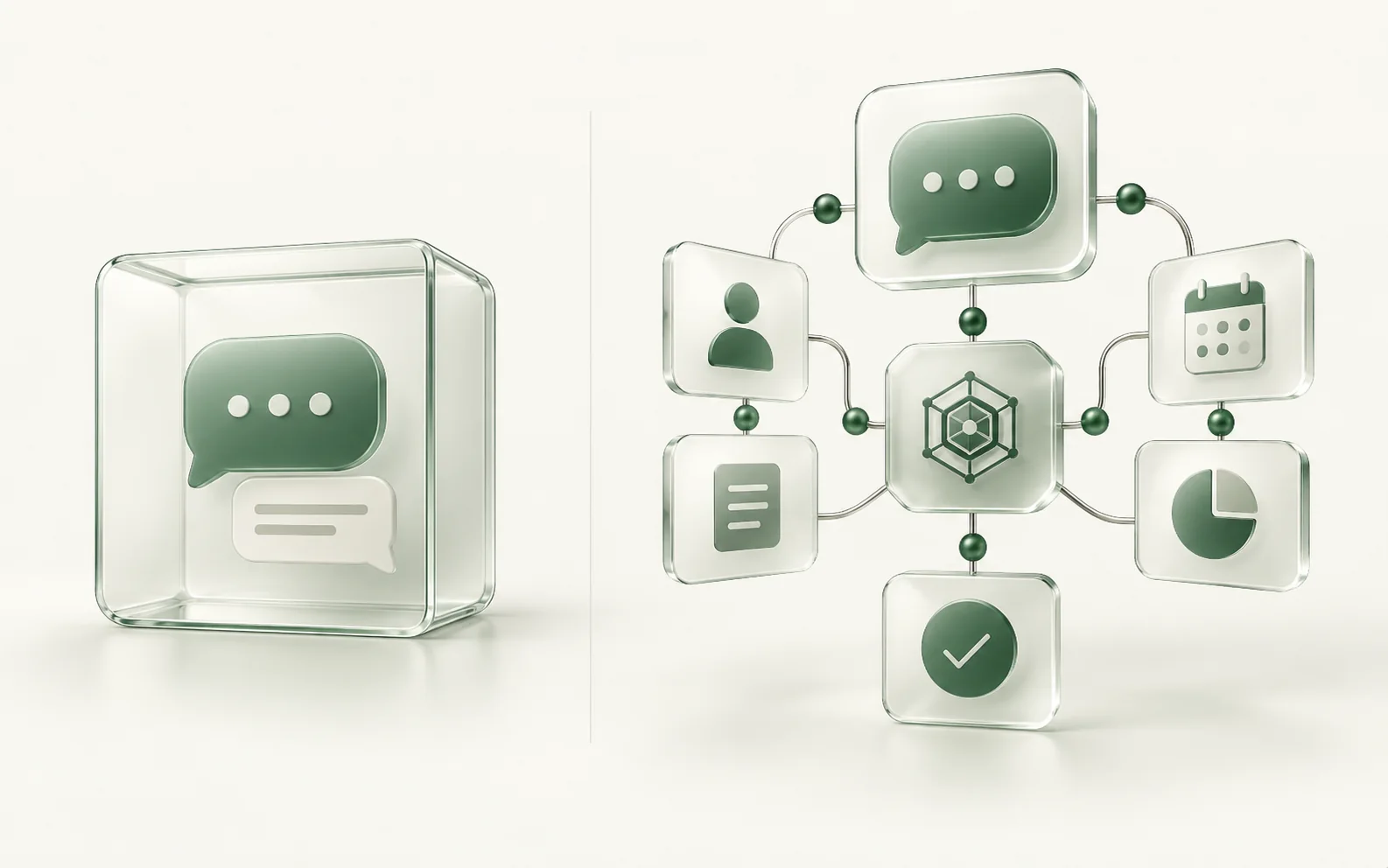
A chatbot can reply. A connected system can move the work forward
Take a real estate business. A prospect says they want to invest up to USD 300,000 in Punta del Este, preferably near the coast, and may rent the property during summer.
A basic chatbot can acknowledge the message and promise a callback. A connected system can identify purchase intent, budget, investment objective and preferences; create the opportunity; check available information; ask for the missing detail; offer a call and hand the case to an advisor with the context intact.
The incoming message is the same. What changes is the operational layer behind the conversation.
What to automate first
For a first implementation, look for work that is frequent, repeatable, verifiable and low risk. Those workflows generate fast learning and make it easier to determine whether automation is actually creating value.
- Information: opening hours, services, general requirements, location and FAQs.
- Qualification: service, budget, dates, location, urgency and language.
- Organization: create a lead, classify the inquiry, summarize it and assign an owner.
- Coordination: offer time slots, request documents, confirm details and prepare a meeting.
- Follow-up: remind a customer of a clear next step when the business rule and authorization are explicit.
Automate one journey first. Expand autonomy only after you have real data on quality, errors and conversion.
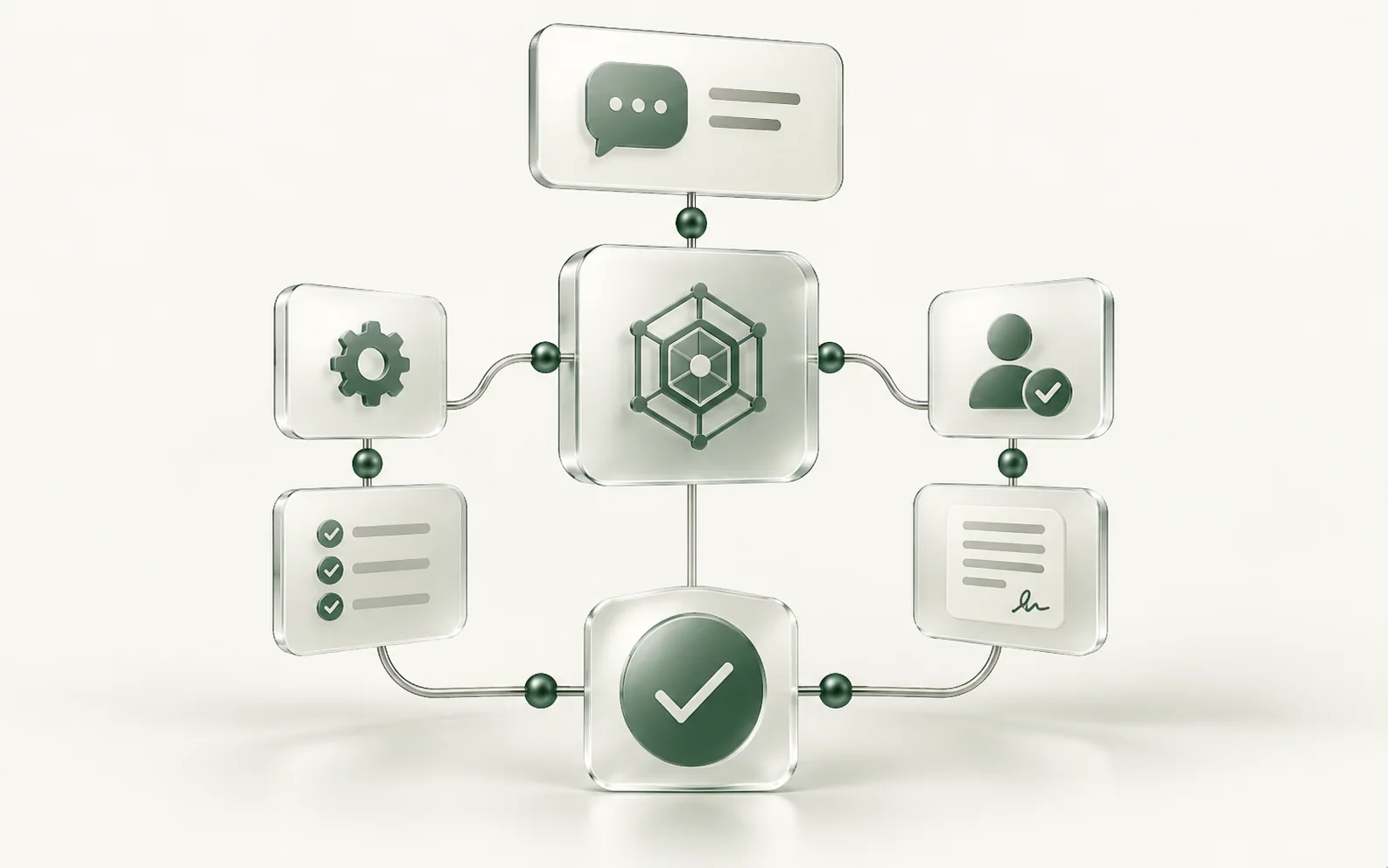
Autonomy should increase in levels, not all at once
The fact that a model can draft something does not mean it should be authorized to send it. A business-grade system separates capability from authority.
AUTOMATIC — AI may execute within clear rules. Example: answer opening hours.
ASSISTED — AI prepares information or a recommendation and a person continues the work.
APPROVAL REQUIRED — AI prepares an action but waits for explicit approval before executing it. Example: sending a commercial proposal.
HUMAN — The task remains outside autonomous scope. Example: a sensitive professional or financial decision.
AI should check real business data before answering business-specific questions
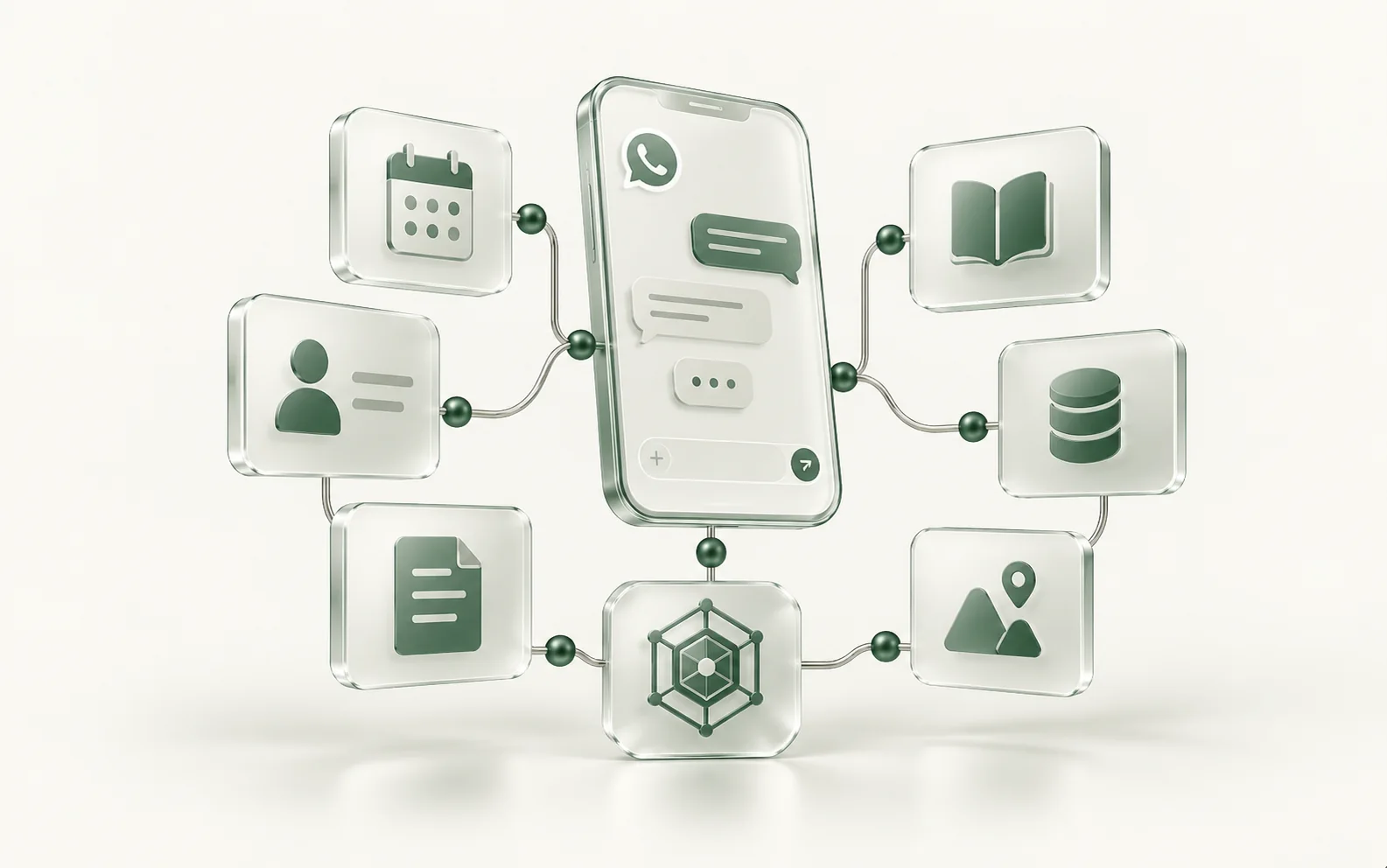
A business system should not rely only on a model's general knowledge. If someone asks about availability, pricing, inventory or the status of a request, the answer should come from an approved source whenever one exists.
The same conversation can connect to tools that turn intent into work: a CRM, calendar, reservation system, catalogue, document repository or internal application. Each integration needs narrow permissions and validation of every tool input.
- Website and approved knowledge base.
- CRM and sales pipeline.
- Calendar or reservation system.
- Catalogue, inventory or current pricing.
- Internal documents and customer-service policies.
Design the human handoff from day one
Not every message should end in an automated response. The system must know how to stop when the customer asks for a person, reliable data is missing, confidence is low or a policy requires human intervention.
The handoff should include context rather than a blank alert. That prevents the customer from repeating the conversation and lets people focus on the parts of the work that require judgment, empathy or accountability.
- The customer asks for a person.
- The action requires explicit approval.
- Sensitive information or an unhandled exception appears.
- There is no reliable source for the answer.
- The opportunity is valuable or complex enough to warrant direct attention.
Should you use your existing WhatsApp number?
If the number is already dedicated to the business, integrating it may make sense. If it mixes customers with friends, family and personal conversations, we generally recommend separating the two and creating a dedicated business number.
The separation makes privacy, analytics, team access, automation and business continuity easier to manage. It also supports different modes per conversation: human only, AI-assisted or autonomous within policy.
Meta provides onboarding paths for WhatsApp Business numbers. The exact setup should be checked at implementation time because it depends on the current account state and the onboarding options available then.
For a new business workflow—or a number that currently mixes personal and commercial use—a dedicated business number is usually the cleaner starting point.
Reference: Meta · Onboard WhatsApp Business app users
Examples: the workflow changes by industry
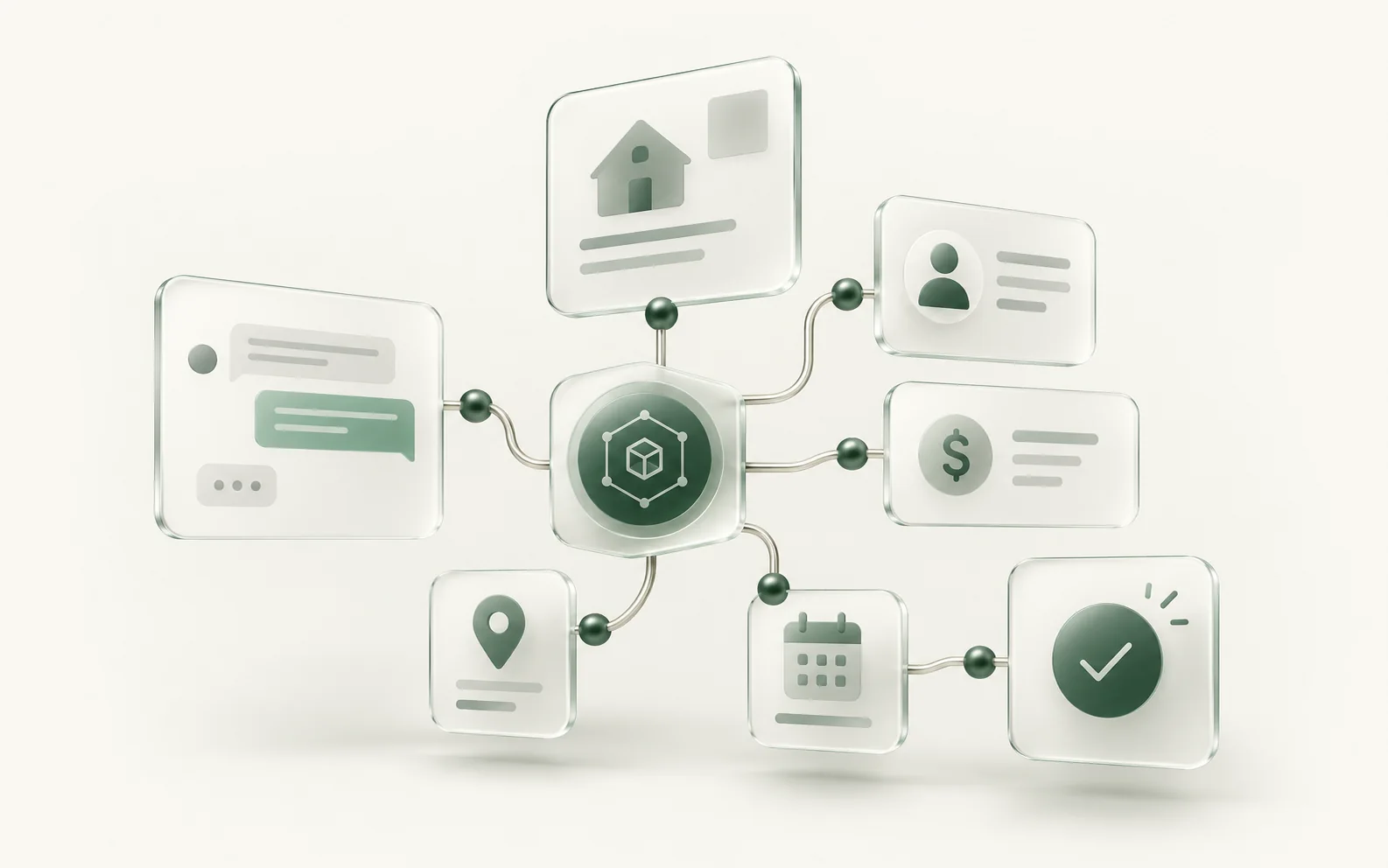
In real estate, AI can collect area, budget, transaction type and investment objective before handing the opportunity to an advisor. In hospitality, it can understand dates, party size and interests before checking availability or preparing options.
For professional services, it can structure intake, request initial information and schedule a consultation while professional judgment remains explicitly human. In commerce, it can check inventory or order status if the underlying integration is reliable.
- Real estate: inquiry → qualification → relevant property → viewing or call.
- Hospitality: dates → availability → preferences → booking or concierge.
- Professional services: need → initial data → documents → human consultation.
- Commerce: product → live stock → price → next purchase step.
What does WhatsApp AI automation cost?
There is no single price. The main components are WhatsApp Business Platform usage, model/API consumption, infrastructure and implementation/integration work.
Meta publishes the current pricing model and may change rates, message categories or conditions. We therefore avoid hard-coding a per-message number in a guide that can quickly become outdated. Customer-service-window rules should also be confirmed in Meta's current documentation when the integration is implemented.
AI cost depends on message volume and length, the models selected, documents, audio, images and tools. An efficient architecture does not use the most expensive model for every message; deterministic logic and different model classes are matched to the task.
- WhatsApp / Meta: current message charges and messaging rules.
- AI: API consumption by model and volume.
- Infrastructure: backend, database, monitoring and storage.
- Implementation: workflow design, integrations, testing, security and maintenance.
Reference: Meta · WhatsApp Business Platform Pricing
Do not compare vendors only on the price of the bot
Two systems can use the same foundation model and produce very different results. Ask what information the system uses, which actions it can take, what happens when it is uncertain, how a person takes over and what evidence remains after execution.
- Are answers grounded in live business data or only a generic prompt?
- Which tools can it use and with which permissions?
- Which actions require human approval?
- What rate limits, quotas and budget controls are enforced?
- Where are credentials stored and who can access them?
- Which logs, costs and evidence are retained after an action?
- How are prompt injection, abuse and sensitive data handled?
Privacy and personal data in Uruguay
Automating WhatsApp means processing personal data. Uruguay has a personal-data-protection framework, and the national data protection authority publishes guidance for businesses, including considerations around messaging applications.
An implementation should document which data is collected, why it is used, which systems receive it, who can access it, how long it is retained and which third parties participate. Risk should drive the design: a restaurant-hours question is not equivalent to legal, medical or financial information.
This is not solved by adding a generic AI disclaimer. The actual data flow and the obligations applicable to the specific business need to be reviewed.
For sensitive data or regulated sectors, legal and security review should be part of implementation rather than an afterthought.
Reference: Uruguay data protection authority · Business guidance (Spanish)
Checklist: does your business have a good first automation use case?
Automation tends to deliver more value when there is volume, repetition and a clear next step. If several of these situations happen every week, there is probably a workflow worth testing.
- We answer the same questions repeatedly.
- Some inquiries are missed or answered too late.
- We ask the same qualification questions every time.
- We copy data manually from WhatsApp into another tool.
- We coordinate time slots or availability manually.
- Information is scattered across WhatsApp, email and spreadsheets.
- We do not know how many inquiries turn into meetings, bookings or sales.
- The team spends too much time on coordination work that is easy to verify.
How to start: one workflow, one outcome, one measurement loop
We would not start with a visual agent builder or by automating the whole company. Pick one high-volume, low-risk journey, define its sources, permissions, success criteria and escalation points.
Then test it with real or representative conversations, measure errors and human time, and expand autonomy only after the workflow is understood.
- 01
New inquiry
- 02
Understand the need
- 03
Answer from approved information
- 04
Qualify
- 05
Record
- 06
Execute or propose the next step
- 07
Escalate to a person when required
- 08
Measure the outcome
The GEM approach: conversation → action → outcome → proof
GEM is not positioned as an isolated chatbot or as a proprietary foundation model. It uses AI models for reasoning and surrounds them with business context, permissions, tools, limits, budgets, human approval and outcome records.
The interface can be Web, WhatsApp or Telegram. The same runtime can receive a message, identify intent and decide which tools are available for that organization and that conversation.
The goal is not to maximize automated messages. It is to determine whether a conversation reached the right next outcome at a reasonable cost and human-intervention level.
- First-response time and time to the next meaningful step.
- Qualified leads, meetings, bookings or sales generated.
- Autonomous resolution rate and human-escalation rate.
- Errors, corrections and actions blocked by policy.
- AI cost per conversation and per outcome.
- Verifiable evidence of executed actions.

Frequently asked questions
Can I connect AI to WhatsApp Business?
Yes. Advanced integrations typically use WhatsApp Business Platform/Cloud API plus a backend that connects the conversation to AI models and, where useful, other business systems.
Do I need to change my WhatsApp number?
Not necessarily. It depends on current use and account configuration. If the number mixes personal and commercial conversations, separating the two is usually cleaner.
Can AI reply automatically?
Yes, but autonomy should be granted by task. Simple questions can be automatic while sensitive actions remain assisted, approval-gated or human-only.
Can a person take over the conversation?
Yes. Human handoff should be part of the architecture from day one, with context preserved so the customer does not have to repeat the conversation.
Can it use my CRM or calendar?
Yes, provided there is a secure integration and narrow permissions for the data or actions involved.
Can it work in Spanish, English and Portuguese?
Yes. Current models can operate across languages, although the customer experience, policies and business sources still need to be designed and tested for each market.
Can AI make things up?
Models can be wrong. Business implementations therefore need approved sources, validated tools, policies, limits and escalation when reliable information is unavailable.
How much does WhatsApp automation cost?
It depends on volume, Meta's current charges, AI models, infrastructure, integrations and workflow complexity. Define the process and target outcome before estimating cost.
Is GEM a chatbot?
We do not position GEM as an isolated chatbot. Conversation is an interface; GEM connects it with context, policies, tools, human approval and evidence.
Sources and references
- Meta · WhatsApp Business Platform Pricing
- Meta · WhatsApp Business Platform
- Meta · Onboard WhatsApp Business app users
- Uruguay data protection authority · Business guidance (Spanish)
Rules, pricing and onboarding processes can change. Official documentation should be checked at implementation time.